Your Guide to the Best Punching Machines

Summary

  • Precision and Speed: Modern CNC punching machines, like the quality ones from Etana Corp, deliver high accuracy and rapid production for parts manufacturers need.
  • Cost-Effective Solution: For high-volume projects, punching offers lower operating costs compared to other methods like laser cutting.
  • Beyond Just Holes: Today’s machines can do more than just punch; they can also form, tap, and countersink, simplifying your whole fabrication process.
  • Find the Best: Choosing the right machine is key to success and that’s where a reliable supplier, like us at Etana Corp, makes all the difference for your business in places like California to Texas and beyond.

Table of Contents

Introduction

  • Are you a manufacturer trying to keep up with high demand orders? Do you need metal components with perfectly placed holes, slots, or unique forms?
  • If so, you already know that a punching machine is one of the most vital tools in your fabrication shop. It’s the workhorse that transforms flat metal sheets into precision-engineered parts for industries from automotive in Detroit, Michigan to electronics in Silicon Valley, California.
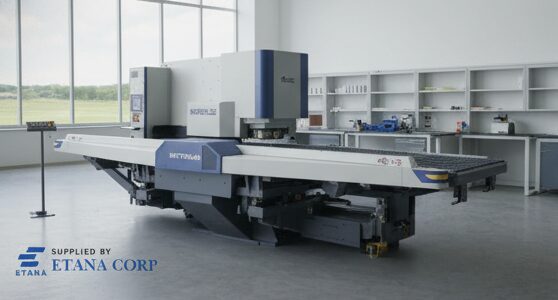
  • Punching machines often called punch presses or perforated metal machines work by quickly forcing a punch through sheet material and into a die to create a clean, accurate cut or hole. 
  • It’s a method that’s been around for ages, but the technology today is nothing short of amazing, especially with Computer Numerical Control (CNC). The latest models are smarter, faster, and more versatile than ever before. 
  • If you’re looking for an upgrade or a reliable machine for a new production line, you need a trusted partner. That’s why we at Etana Corp are dedicated to being the best fabrication and CNC machine suppliers in the United States, providing quality equipment to manufacturers in all states.

Advantages and Disadvantages

Understanding how these powerful machines work is surprisingly simple! Think of a common hole punch for paper, but on a massive, industrial scale, controlled by a computer. The basic action involves two main parts: the punch (the top tool) and the die (the bottom tool).

Process

  1. Placement: The metal sheet, often called the workpiece, is precisely positioned on the machine’s table, usually by powerful clamps.
  2. Activation: The computer (CNC system) tells the machine exactly where to go and what tool to use.
  3. The Hit: The punch comes down with tremendous force, shearing the metal sheet against the die.
  4. The Result: A clean piece of material, called the slug, is removed, leaving a perfectly formed hole or shape. The sheet is then quickly moved to the next punch location.

Types

Type of Press

Drive Method

Best For

Mechanical Press

Converts rotational motion into linear motion.

High-speed, continuous operations with lighter materials.

Hydraulic Press

Uses pressurized fluid (oil) to generate force.

High-tonnage jobs, deep drawing, and forming operations.

Pneumatic Press

Uses compressed air to power the punching action.

Lighter tasks requiring quick cycle times and simple operation.

Servo Press (CNC)

Uses electric motors for highly controlled movements.

Precision, complex shapes, and high-quality, repeatable work.

Key Features

  • High Speed Turrets: Quick tool changes mean less downtime and more parts per hour.
  • Automatic Tool Lubrication: Extends the life of your valuable punches and dies.
  • Sheet Clamping Systems: Systems that reposition the metal sheet automatically for maximum material use and complex jobs.
  • Forming and Tapping: The ability to not just punch, but also create forms like louvers, ribs, and threads on the same machine—saving you time and secondary operations!
  • Waste Management: Automated slug removal and scrap sorting to keep the work area clean and safe.

Advantages

  • Forming Capability: Punching can create 3D forms (like louvers, countersinks, and threads) that laser cutting cannot.
  • Speed for Holes: For parts requiring many simple holes (like perforated sheets), a punch press is significantly faster often 10 times faster than a laser.
  • Cost Efficiency: Tooling costs are a one-time investment, and the operating costs (especially with modern servo-electric punches) are generally lower than those of a high-power laser.
  • Material Thickness: Excellent for working with thicker sheet materials, providing clean edges.

Disadvantages

  • Intricate Designs: Punching struggles with very complex or irregular contours and fine details. A laser can cut almost any shape.
  • Tooling Investment: You must purchase specific tools (punches and dies) for every shape you want to make, which is an initial investment.
  • Material Usage: Punching requires clamps and borders, which can lead to slightly more material scrap compared to laser nesting.

The Heart of Your Punching Machine

The punch and die set, collectively called tooling, is the true “business end” of your machine. Choosing the correct tooling is essential for maintaining quality and machine longevity. A poorly chosen or maintained punch can cause burrs, premature wear, and machine damage.

Key Factors

  • Material Type and Thickness: Harder materials, like stainless steel, require tougher, specialized tools, sometimes with special coatings like Titanium Nitride (TiN) to reduce friction.
  • Hole Shape and Size: You need tooling that matches the exact shape you intend to create (round, square or oblong).
  • Die Clearance: This is the small gap between the punch and the die. It’s a precise measurement usually 5% to 10% of the material’s thickness. Incorrect clearance leads to poor hole quality.
  • Press Capacity: Always ensure the force needed to punch the material doesn’t exceed 80% of your machine’s rated tonnage.

Maintenance

Even the best fabricated machine needs love and care to deliver peak performance day in and day out. Following a strict maintenance schedule ensures your equipment lasts for years, reducing costly downtime that hits your bottom line.

Daily and Weekly Maintenance

  • Cleanliness: Wipe down the work surfaces and remove all metal shavings (slugs) and debris from the turret and die holders.
  • Tool Inspection: Check punches and dies for chipping, cracks, or signs of wear. A dull punch is a bad punch!
  • Lubrication Check: Verify that all automatic lubrication systems are working and that all moving parts have the necessary grease or oil.

Monthly and Quarterly Maintenance

  • Fluid Levels: Check and maintain the oil level and condition in the hydraulic system (if applicable).
  • Alignment: Inspect the machine’s overall alignment, ensuring the punch enters the die perfectly centered. Misalignment is a top cause of tool breakage.
  • Electrical System: Inspect cables and connectors for damage, and clean the electrical cabinet to prevent overheating.
  • Review Records: Keep a log of all maintenance, tool replacements, and any issues this helps in predicting future needs.
  • A proactive approach to maintenance keeps your business running smoothly, whether you’re fulfilling orders in Boston, Massachusetts, or servicing the oil industry in Houston, Texas.

Benefits for US Manufacturers

The decision to invest in high quality punching machinery is a clear move to future-proof your business. It’s not just an expense; it’s a commitment to efficiency and quality that customers notice.

Key Benefits

  • Superior Accuracy: CNC controls mean your parts have high repeatability with tight tolerances, a must for seamless assembly.
  • Increased Productivity: The speed of punching dramatically reduces the time it takes to process metal sheets, increasing your output volume.
  • Lower Part Cost: For high-volume production, punching is the most cost-effective method per part.
  • Versatility: With a wide selection of tools, one machine can handle numerous tasks: not just holes, but also tapping, marking, and forming.
  • Reduce Secondary Operations: By combining punching and forming, you save time and labor costs associated with moving parts to other machines.
  • Ready to see how a new, high performance machine can transform your operation? We are here to help you get the absolute best equipment for your specific needs. Etana Corp is dedicated to supplying American manufacturers with the best fabrication and CNC machine suppliers in the United States.

Latest Innovations in Punching Technology

The world of metal fabrication is always moving forward, and punching technology is no exception. Modern innovations are focusing heavily on automation, energy savings, and smarter controls.

What’s New and Exciting?

  • Servo-Electric Drive: The shift from hydraulic to electric drives offers a cleaner, quieter, and highly energy-efficient operation. They use power only when the punch is actively working.
  • Advanced Sensors and AI: Machines are now equipped with sensors that can detect tool wear, material irregularities, and even automatically adjust punch force for optimal results.
  • Integrated Automation: Full automation is becoming standard, with robotic systems for loading, unloading, and part sorting, allowing for lights-out manufacturing (running the machine with no human staff present).
  • Cloud Connectivity (IoT): Real-time monitoring and diagnostics through the cloud allow manufacturers to track performance and schedule predictive maintenance from anywhere, from Phoenix, Arizona, to Philadelphia, Pennsylvania.
  • If you’re looking for the most advanced, smart machinery available, you need to check out what we are currently supplying. Our commitment is to bring these latest innovations to manufacturers across the entire US.

Why US Manufacturers Choose Etana Corp

Manufacturers in the United States face unique challenges, including high labor costs and the need for peak operational efficiency to compete globally.

Targeting Your Needs

Manufacturer Need

How Etana Corp Meets It

High Labor Costs

Supply state-of-the-art CNC machines with automation to reduce manual labor.

Demand for Quality

Offer only high-precision equipment to meet tight aerospace and automotive tolerances.

Quick Turnaround

Provide fast, high-speed machines that increase production volume and throughput.

Reliable Support

Offer expert local support, parts, and service across the entire country, including midwestern states and the Northeast.

Conclusion

Choosing the right punching machine is a critical business decision that affects your production quality, speed, and profitability for years to come. Whether you’re upgrading an old hydraulic machine or expanding your capabilities with a brand new CNC turret punch, you need equipment that is reliable, precise, and backed by a company you can trust.

That’s why manufacturers from Oregon to North Carolina consistently choose Etana Corp. We pride ourselves on being the best fabrication and CNC machine suppliers in the United States, stocking high quality, modern, and efficient machinery. We are here to help you solve your most demanding production problems. Don’t settle for less partner with us and give your business the competitive edge it deserves.

faq’s

What is the main difference between a CNC Punching Machine and a Press Brake?

A CNC Punching Machine is primarily designed to create holes, cutouts, and simple forms in flat sheet metal. A Press Brake is designed to bend and fold sheet metal into angles and 3D shapes. They are often used together in a fabrication shop.

Not always! While the initial setup for a CNC punch (including tooling) can be an investment, for high-volume production of hole-intensive parts, CNC punching has a much lower cost per part due to its speed and lower operating energy consumption compared to laser cutting.

The lifespan of punches and dies depends heavily on the material being punched and proper maintenance. With correct die clearance and regular sharpening, high-quality tooling can last for hundreds of thousands of hits before needing replacement.

The turret is the rotating disc on a CNC punch press that holds many different punches and dies. It allows the machine to quickly switch between tools to create various shapes and sizes without an operator having to stop production to change the setup manually.

Disclaimer

The information provided in this blog post is for general informational and commercial purposes only. While Etana Corp strives to provide accurate and up-to-date information, the performance, capabilities, and suitability of any fabrication equipment, including punching machines, depend entirely on the specific application, materials used, maintenance schedule, and operating conditions. Always consult with a qualified engineer or an Etana Corp specialist before making a final purchasing decision or modifying your manufacturing processes. The technical details, innovations, and market comparisons are based on current industry standards and are subject to change.

References

Contact us

How can we help?