
If you’re a manufacturer in the United States right now, you know that keeping your production line fast, precise, and profitable is the name of the game. Maybe you’re currently using older technology, or perhaps you’re planning a major upgrade to handle complex jobs and tighter deadlines. Whatever your reason, you’ve landed on the right page because you’re looking to invest in a machine that will deliver real results, and that means looking at the mighty fiber laser machine.
This technology isn’t just an improvement; it’s a complete revolution for sheet metal fabrication and metalworking across the nation. We want to clear up any confusion and give you the facts you need to make a smart buying decision. Our goal is simple: to connect you with the highest-value fabrication machinery on the market. That’s where we, the team at Etana Corp, excel. We are proud to be the best fabrication and machine suppliers in the United States, ready to serve you from our roots in Texas to every state in the union.
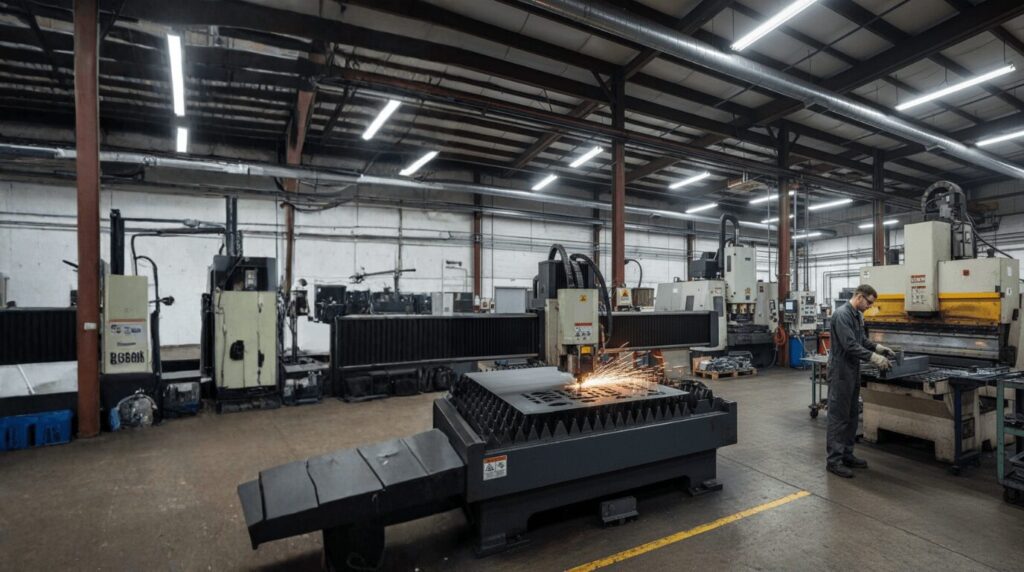
Have you ever wondered what makes these machines so powerful? It’s simpler than you might think. A fiber laser machine is a type of industrial cutting tool that uses an optical fiber as its core component to create an incredibly focused, high-powered beam of light.
As you shop for a new fabrication machine in the United States, you can’t afford to overlook the details that separate an average system from a truly transformative one. Therefore, focus on these key specs:
If you are looking to purchase high-quality and metal fabrication tools and equipment United States, we encourage you to check our product catalog to see our range of high-performance machines.
Not all fiber lasers are built the same. Manufacturers have distinct needs, which is why various types of laser cutters exist. Knowing the difference helps you choose the perfect machine for your sheet metal fabrication business.
Laser Type | Best For… | Key Advantage |
Flatbed | High-volume sheet processing | Largest work area, highest speed |
Tube/Pipe | Precision tube structures | Cuts complex angles and holes |
Combined | Versatile job shops | Flexibility on one floor space |
Advantages | Disadvantages |
Superior Precision: Delivers extremely accurate parts with a very small kerf (cut width). | Initial Investment: The purchasing price (capital expenditure) is substantial. |
High Throughput: Increased cutting speed means you can process more orders, leading to higher revenue. | Reflective Materials: While better than ultra-thick reflective metals can still be challenging. |
Low Operational Cost: Reduced electricity consumption and fewer consumables compared to older equipment. | Thick Plates: For very thick plates, plasma cutting or high-power may still be considered by some. |
Future-Proof: Easily integrates with automation and CAM (Computer-Aided Manufacturing) software. | No Installation/Training: As a supplier, we provide the best machine; however, we do not provide machine installation or operator training. |
A high-quality fabrication machine is designed for durability, but a smart B2B owner knows that proactive maintenance is crucial for preventing costly downtime. Furthermore, since we do not provide installation or training, knowing these basic steps is critical for your team.
The year is all about smart manufacturing, or Industry 4.0. The fiber laser is leading this change with the integration of AI (Artificial Intelligence) and advanced software. This is not just a trend; it’s a reality that drives efficiency.
Feature Name | Function/Benefit for B2B Buyer | Impact on Production |
AI-Powered Nesting | Software uses algorithms to fit parts onto a sheet, sharing cut lines to minimize scrap metal. | Reduces Material Waste by 10% or more. |
Predictive Maintenance | Sensors monitor component health (spindle, power source) and forecast potential failures. | Minimizes Downtime by allowing scheduled maintenance before a breakdown. |
Wobble Head Technology | Allows the laser beam to oscillate slightly, improving edge quality and reducing dross on thicker metal. | Reduces Finishing Time and improves part quality. |
Cloud Monitoring | Allows plant managers in Atlanta, Georgia, or Phoenix, Arizona, to check machine status remotely. | Improves Oversight and operational control. |
You’ve learned about the technology, the latest features, and the importance of minimal maintenance. The next, most critical step is choosing the right supplier. For manufacturers in the United States, choosing a reliable partner is essential for long-term success.
At Etana Corp, we pride ourselves on being more than just a supplier; we are a partner to your manufacturing success. We carefully select and deliver only the highest-quality, most technologically advanced fabrication and CNC machine systems available today. Whether your shop is in Michigan, boosting the automotive sector, or in Washington, driving aerospace innovation, we serve you nationwide. We are the best fabrication machine in the United States suppliers because we focus on high-value, high-performance machinery.
Ready to boost your efficiency and minimize downtime?
Don’t wait, Request a personalized quote today and see the Etana Corp difference for your operation!
Investing in a fiber laser machine is a move to future-proof your business. It means embracing high-speed, high-precision, and the low-maintenance reliability that only modern fiber systems can provide. By understanding the key features, like high-power sources, automated material handling, and smart controls, you are now equipped to make a truly informed decision.
Etana Corp is here to supply your factory with the high-performance CNC fabrication machine you need. We encourage you to explore our line of laser cutters and press brakes.
Contact us now to discuss your specific production needs and get a quote for a machine that will transform your factory floor.
The power you need depends directly on the thickest metal you cut and your required production volume. For high-volume cutting of thin metals is often sufficient. For thicker plate metal or structural steel, you should look at higher-power systems to maintain speed and cut quality.
TOC is much lower than older lasers due to fiber’s high energy efficiency and lack of expensive optical components or gases. The main costs are the initial price, power consumption, and consumables like nozzles and filter cartridges. Maintenance costs are typically very low, especially with modern systems utilizing predictive maintenance.
For most industrial metals, mild steel, stainless steel, aluminum, brass, and copper, fiber lasers are generally superior due to faster cutting speeds and better energy absorption. Lasers historically had an edge on very thick mild steel, but newer, high-power fiber lasers are rapidly closing that gap and are often preferred for overall versatility.
As high-ticket B2B suppliers, Etana Corp understands that manufacturers require flexible purchasing options. We work with various financial partners to provide competitive financing and leasing plans. Please request a quote to discuss the options best suited for your capital expenditure budget.
Etana Corp supplies machines from top manufacturers, and the warranty typically covers major components like the laser source and cutting head for a set period. We facilitate all manufacturer-backed technical support and parts supply, ensuring your team has the resources needed to keep the machine running.
The information provided in this blog post is for educational and informational purposes only. While Etana Corp is a proud supplier of high-value fabrication and machine systems, this information is not intended as a substitute for professional engineering or technical consultation. Etana Corp does not provide machine installation, hands-on operator training, or setup services. All buyers should ensure they have qualified personnel or third-party contractors for machine commissioning and operation. Always consult the specific manufacturer’s manual for safety and operational procedures.
WhatsApp us